Nearly 10 mills in modeled annual savings
The final report's tax model removes 13.3627 Village mills and adds 3.3761 Township police mills—a net reduction of 9.9866 mills for property in the former Village.
A data-backed case for disincorporation
Lake Orion can remain a place, a community and an identity while residents stop paying nearly 10 mills each year to maintain a separate Village government.
The August 2026 final report uses the current project tax, debt and transition assumptions documented in the study.

This one-page summary presents the central findings: the modeled tax savings, the functions that transfer, the services and community traditions that continue, and the treatment of existing debt.
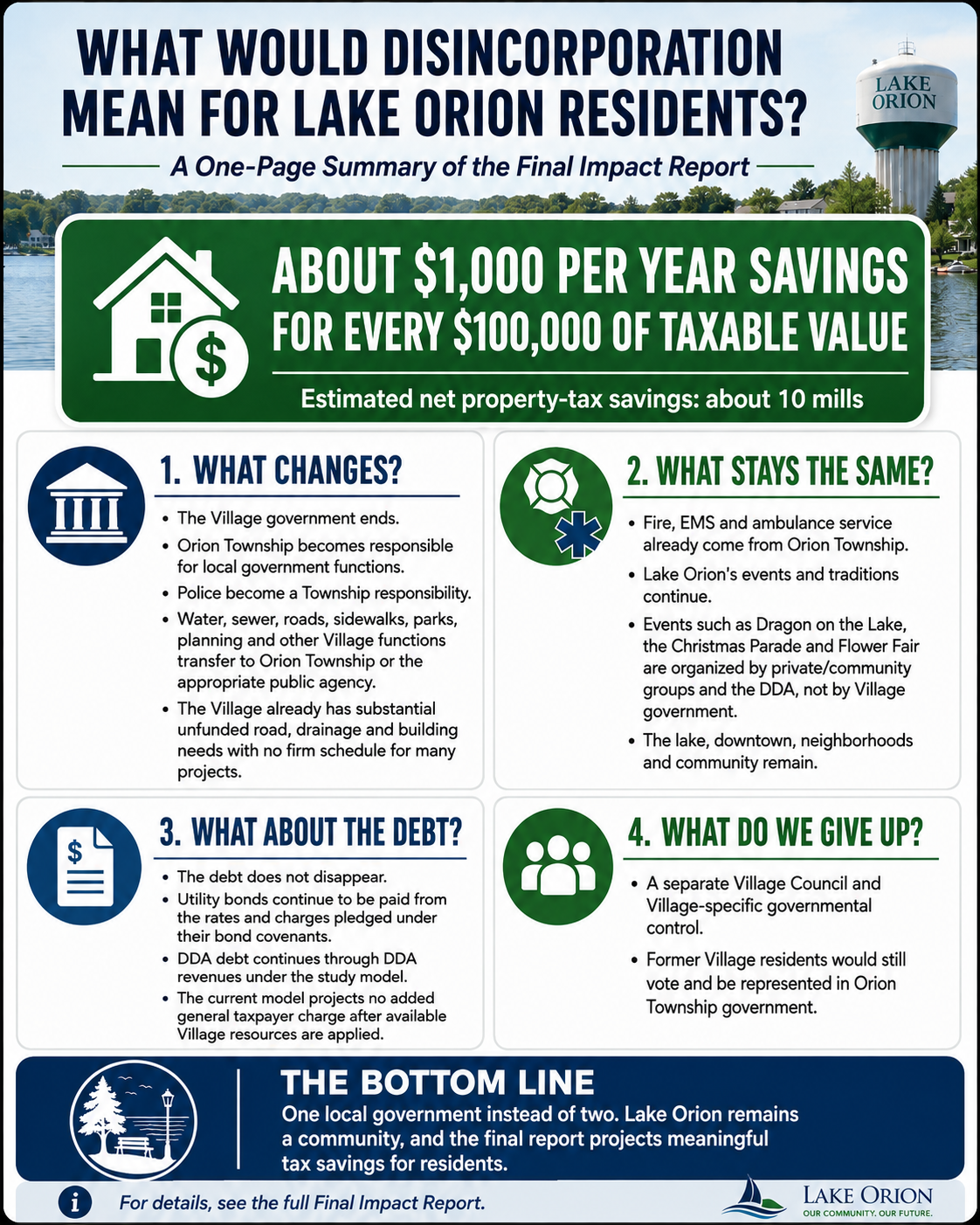
The central question is simple: does a separate municipal structure provide enough additional value to justify its recurring cost? The study’s modeled answer is no.
The final report's tax model removes 13.3627 Village mills and adds 3.3761 Township police mills—a net reduction of 9.9866 mills for property in the former Village.
Village residents already live in Orion Township, vote in Township elections and pay Township taxes. Disincorporation ends the cost of maintaining a second municipal structure.
Fire, EMS and ambulance service already operate Township-wide. Water, sewer, roads, parks, public safety and downtown obligations continue under a documented transition.
A government dissolves—not the lake, downtown, schools, neighborhoods, traditions or community identity. The place and the people continue.
Enter your taxable value—not market value—to estimate the report’s annual property-tax reduction at 9.9866 mills.
Estimate uses the report's 9.9866-mill net reduction. It does not include utility bills, special assessments or changes outside the model.
Read the evidence
The August 2026 final report combines the executive report, ten supporting reports, a resident summary, and primary-source and final-report notes.
Disincorporation is not a promise that every cost disappears. It is a decision to deliver necessary services without maintaining a separate Village government.
Already provided throughout the Village by Orion Township; no new emergency-service system is needed.
The Village department would end. Orion Township would become responsible for policing the former Village area through its successor model.
The systems, customer bills, capital work and lawful debt continue. Township becomes the responsible municipality.
The report's working model continues the DDA under Orion Township, with its plan, revenue, contracts and debt carried forward.
The need for repair is inherited. Consolidation changes responsibility; it does not make paving costs disappear.
The Township already supplies building permits and inspections by contract, so this transition is comparatively small.
The report tests the best arguments against disincorporation and still concludes the recurring savings and simpler structure have merit.
No. Water and sewer obligations, DDA bonds, restricted funds, capital needs and lawful liabilities follow their purposes. The savings case rests on eliminating Village-specific government cost—not pretending every obligation vanishes.
No. The name, downtown, lake, neighborhoods, schools, organizations and traditions remain. Disincorporation changes the municipal corporation, not the community.
The Village Council and Village-only offices end, and Township institutions make municipal decisions. That is a real tradeoff. Residents gain one government with a broader tax base and one place to hold accountable.
The report finds 95.2% of the Village network in poor condition. That deterioration is inherited—it is neither caused nor cured by disincorporation. A successor still needs a transparent repair and funding plan.
The final report uses the current project tax model: 13.3627 Village mills removed, 3.3761 Township police mills added, for a 9.9866-mill net reduction. If later certified tax data supersede those figures, the calculations should be updated consistently.
Start with the complete study, then follow the underlying law, audit, infrastructure and service sources.
Advocacy disclosure: This site supports Village disincorporation. It is not an official communication of the Village of Lake Orion, Orion Township or Oakland County. The final report is a public-policy and financial analysis, not a bond-counsel opinion.
Study dated August 2026